Wild weekend: Illini beat USC, I improve (slightly) in the half marathon

It is now Sunday. And I had some flashbacks to the past. And here is the truth:

USC football is not what it was during the John McKay, John Robinson and Pete Carrol days. The colors are the same, the fight song is the same, but the team is not.

I am not what I once was; my lifetime PBs for the half marathon are 1:34 as a runner and 2:17 as a walker. And for a period in my life, 2:20-2:40 was an all but guaranteed result as a walker. Those days are over. Completely.

Nevertheless, I had a lot of fun this weekend.

Saturday: Harry was my “date” for the USC game.

Note where they put the USC band.

The parachute team was spectacular.

Oh, the game: it was an interesting one. USC got the ball, promptly marched it into Illini territory and fumbled it away. The Illini drove it for a touchdown; the Illini offense was to rack up 500 yards of offense today. The Trojans promptly tied it with a march of their own; the teams were to punt one time apiece. The Illini retaliated 14-7 and, after a 4’th down stop, were threatening to make it 21-7, when the Trojans got a controversial fumble recovery. Then they marched it down to make it 14-10 at the half.

Second half: Illini got a field goal, and interception and then hit a swing pass to go up 24-10. No problem: USC drove it again to make it 24-17. The Illini got yet another touchdown to make it 31-17, which was the score going into the 4’th. The Trojans: once again, they used their excellent receivers to score and hit a 2 point conversion to make it 31-25.

Now it was the Illini’s turn, but they fumbled going into the Trojan end zone. This would have iced the game. Instead, the Trojans took the lead on a nifty pass and were up 32-31 with about 2 minutes to go.

That was too much time: the Illini promptly drove it to field goal range and their excellent kicker nailed it from 41 yards as time expired.

What a game! What a bounce back performance from the Illini after last week’s massacre at Indiana.

Yes, the Illini defense got shredded; that will be an ongoing problem.

Sunday

I drove to Quad Cities last night and stayed 4 miles away. I was to do the half marathon. The morning started at 59 F and was to get warmer, but the half marathon course managed to feature quite a bit of shade. That helped.

The result: 3:01:27, which was 2 minutes faster than last year. What cost me sub 3 hours: not enough training miles AND being around 200 lb. That is too heavy: I should be in the mid to high 180’s

I got into rhythm early and mostly ignored my watch. With the exception of that LOOOOONG pedestrian bridge next to I 74, I mostly maintained high 13s. The course was very intelligently designed; mile 2 was on the bridge and the marathoners reached it later, hence it never got crowded. I was treated to seeing the faster marathon runners.

Yes, at my walking pace, I was mostly the old, lame (I had knee braces) and heavier than optimal (see my remarks about my being too heavy). But, I am grateful for the longer time limits and for the opportunity to walk the course.

I admit that I teared up before the start; I wonder how much longer I’ll be able to do these. But I smiled at the finish; even though I did not have the reserves to take the final 1.1 miles fast. I was mildly surprised that I beat my last year’s time .

What I did right: 18 ten mile walks over the previous 20 weeks, heat conditioning. I also had a good attitude: “just walk; don’t be a slave to the watch.” And orange juice at mile 5 helped: I never got sick.

What I did wrong: too heavy, not enough training miles, and my 5k walk is too slow.

splits: 13:39, 14:22, 13:23, 13:42, 13:57 (1:09:05)
14:12, 13:47, 13:44, 27;33 (2 mile) 2:18:22
13:19, 13:49, 15:58 (14:30 pace)

My half marathon walks: (no running at all in any of these) Note: most links are broken.

September 2003: 2:17 (Appleton Fox-Cities powerwalk division)
January 2008: Austin 30K 3:50:56 (about 2:40 for the half marathon split)
September 2008: 2:25:13 Quad Cities
September 2010: 2:39:13 Quad Cities (surgery that summer)
September 2011: 2:40:53 IVS
September 2011: 2:22 Quad Cities
January 2012: 2:34 First Light
June 2012: 2:30:18 Galesburg
September 2012: 2:24:46 IVS
April 2014: 2:25:26 Peoria Heights
May 2014: 2:19:15 Peoria
September 2014 2:35 (IVS)
September 2014 2:24:17 Quad Cities
September 2015 2:38:13 IVS
June 2017: 2:47:24 Galesburg
July 2017 2:42:19 Chicago RR
August 2017 Mahomet Half marathon 2:52:33
October 2018 Whisky Daddle Half Marathon 2:29:23

August 2024: Mahomet Half Marathon 3:05:09.

September 2024: Quad Cities Half Marathon 3:03:37

September 2025: Quad Cities Half Marathon 3:01:27

Quad Cities History
1998: 3:55 as a runner (hot)
1999: 3:45 as a runner
2000: 1:40 for half of a relay
2001: 1:49 for half marathon (week after giving blood)
2002: 4:44 marathon as a walker
2004: 5:12 marathon as a walker
2005: 5:34 marathon as a walker.
2007: DNF at mile 23 (walker)
2008: 2:25 half marathon (walker)
2009: 5:28 marathon (as a walker)
2010: 2:39 half marathon (as a walker; knee surgery in July).
2011: 2:22:27 (half marathon powerwalk)
2013: 2:20:59 as a runner
2014: 2:24:17 powerwalk.
2016 DNF mile 20 (run/walk) heat
2017 DNF mile 20 (walk) heat
2018: Marathon powerwalk 6:14:11.
2019: Marathon powerwalk 6:42:06

2020: virtual 1/2 3:33:50

2024 Half Marathon walk 3:03:37

2025 Half Marathon walk 3:01:27

Marathon: you do not “need” to do one..and it is ok to wait.

This post on Threads lead to a rather sharply worded response from me.

Note: the account holder DOES post some good stuff; I can recommend the account to runners. But..

“Excuse?” I suppose I can interpret that as him talking to someone who WANTS to do a marathon but is trying to talk themselves out of it. And, to be fair, that might apply to a group of people that is larger than the group that I am in.

Yes, I’ve finished the marathon (or beyond) distance 62 times (a few times fewer if you do not count my DNF in the 100)

And, no, I was not good at it. My PR as a runner is 3:33 in 1980, master’s is 3:38 in 2000. I did several as a walker (walking 100 percent of the time) and my last time was in 2019; it took me 6:42 (walker)

No, I am never saying “never again”, but given the tenuous health of my knees (currently tolerating 10 miles fairly well) and lumbar, I am NOT doing a marathon in the foreseeable future. And that is right decision, for ME at my current stage in life. Now, if I drop from 195 lb to, say, 178 lb…who knows? Right now, 10 miles is very comfortable but I’ll need 18-20 miles to feel that way before I start looking. It *could* happen, though I don’t see it as likely.

But here is my point: I did my first marathon when I was 21 and, frankly, I did not know what I was doing. But I was doing 15 miles at 7:40-8 minutes a mile, and could do a 5:30 one mile and a 19:20 3 mile (just at 20 for a 5k) and had run for sports for YEARS. I did not go from “couch to marathon.”

I honestly think that way too many never give their bodies a chance to adjust to running first and end up walk/jogging/shuffling to a 6 hour plus marathon.

And, well, the marathon is hardly the pinnacle of running achievement. For example, a 22 minute 5k is much better accomplishment than a 5 hour marathon.

As an aside, I talked to the young man who fit me for walking shoes. It turns out that he is pretty proud of his sub 2 minute 800, and he SHOULD be. That is harder than people think.

Aging and working out: right now

I’ve wanted to talk about this for a while. What is different about my workouts now than before? Note: I am 65

Of course, I’ve changed what I do: running no longer works (severe patellofemoral osteoarthritis in each knee) and swimming the crawl: I have not learned how to NOT extend (arch) my lower lumbar. And I’ve modified other exercises:
Mostly trap bar for the deadlift and wagon wheel plates for the straight bar (mostly), taking the leg drive out of the bench press (feet on a chair) and switching to the high incline (supported) instead of standing shoulder press. Pull ups: keep the knees in front of the body. This induces a small “kip” which would DQ me in a competition.

But here is the major stuff:

  1. Lots of daily PT for the lumbar, shoulder and a bit for the knee. I do this in the morning.
  2. Longer recoveries are needed after strenuous workouts. Go too long or too hard, and it affects my job. It is even more difficult to climb stairs.
  3. Aches and pains: I almost always have them. But they are far worse if I don’t move. So, it is workout and hurt a little bit (at first) or do nothing and hurt a lot more.
  4. Recovery from injuries or flare ups: MUCH longer these days. This is why I am more conservative.
  5. Pushing my limits: FAR less frequent these days. I rarely try for a max effort with the weights or with a walking race. Recovery takes longer and I want to limit the risk of injury.
  6. Performance! At my current bodyweight: at one time in my life, I could bench press 260 lb (310 is my max, but at 40 lb heavier body weight) I could do a set of 20 “less than perfect” pull ups; now 7-9 is a challenge. I can’t quite get the 10’th cleanly. Pull ups used to be 20-10-10-10 or 15-15-10-10. Over time I’ve changed to doing sets of 5-7 and even singles. Walking: last year I got under 11 minute miles for a 5K and 4 mile race, and 3:05 for the half. In terms of my walking, my unjudged PR (not being sloppy) is 29:2x and half (monitored) was 2:17 but this was 2003. My judged PR: 30:42 and 20k was 2:24 (about 2:33 for the half) Again, this was 2003. As a runner: 19:00 for the 5k, 1:34 for the half (1982 and 1998 respectively) .

In terms of the 5k (a nice benchmark), I said goodbye to sub 20 in 1999 (last did it in 1998), sub 22 in 2002, sub 24 in 2009 and sub 25 in 2014 (last time was 2014)

BUT the good part: at 65, I am feeling the way I expected to feel at 50. At 50, I still had some gusto and still could run the 5K in 24:00 or so, and at 49 I could barely break 7 minutes for the mile. 1999 (at 39) was my final sub 6 minute mile (5:59) 1998 I could run a 5:41 1600 and I last did 5:30 in 1982.

So…no, age is NOT “just a number” for me.

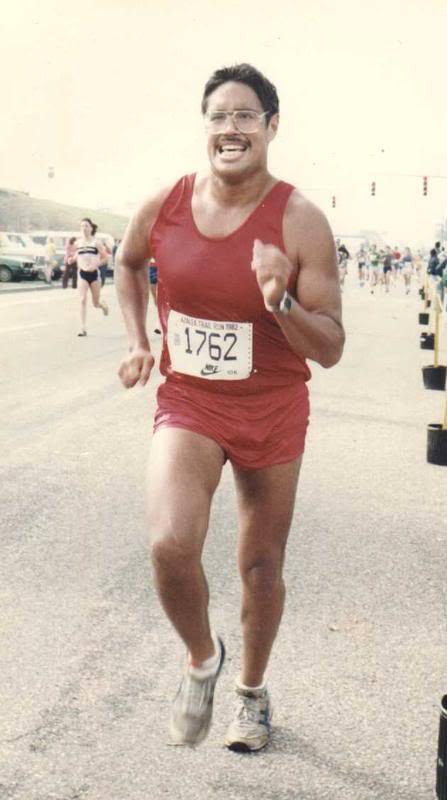
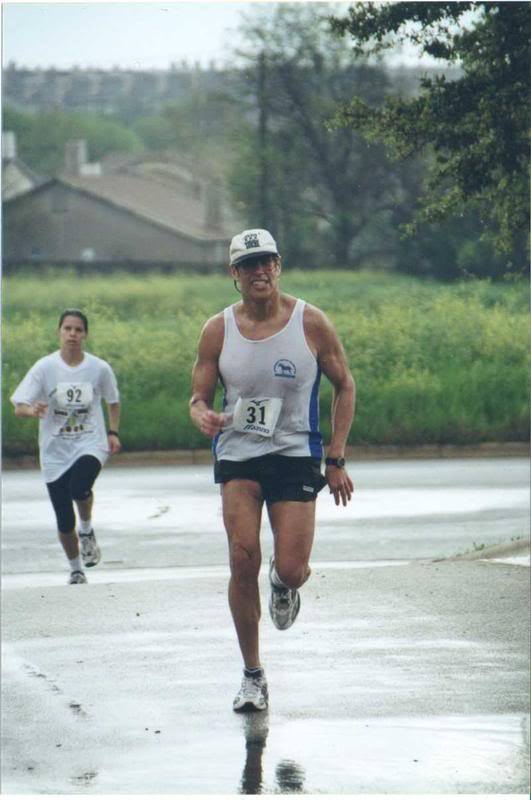
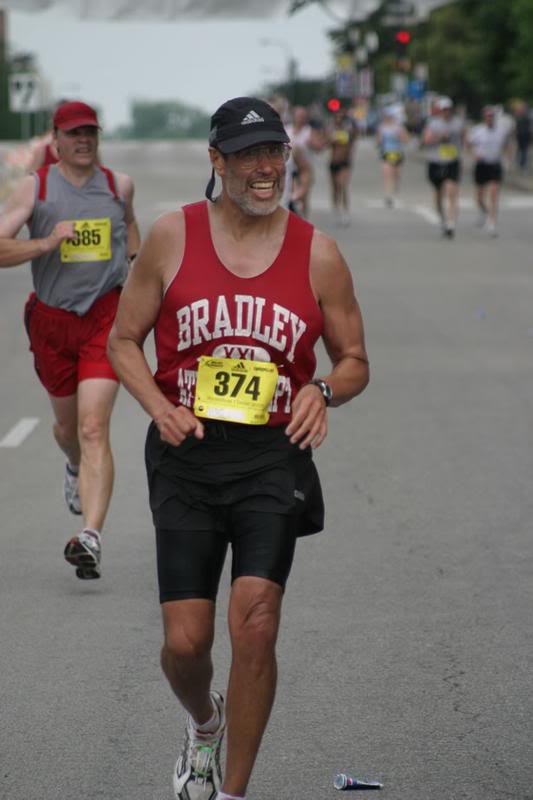
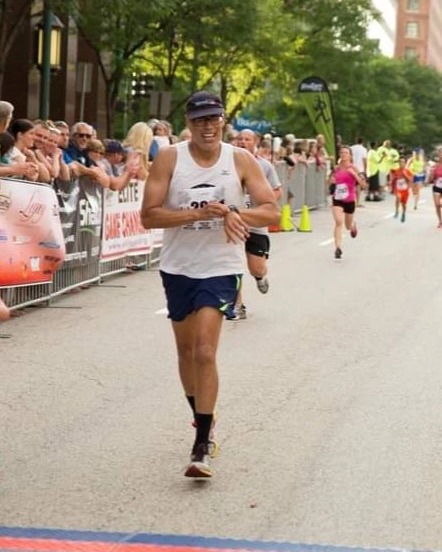
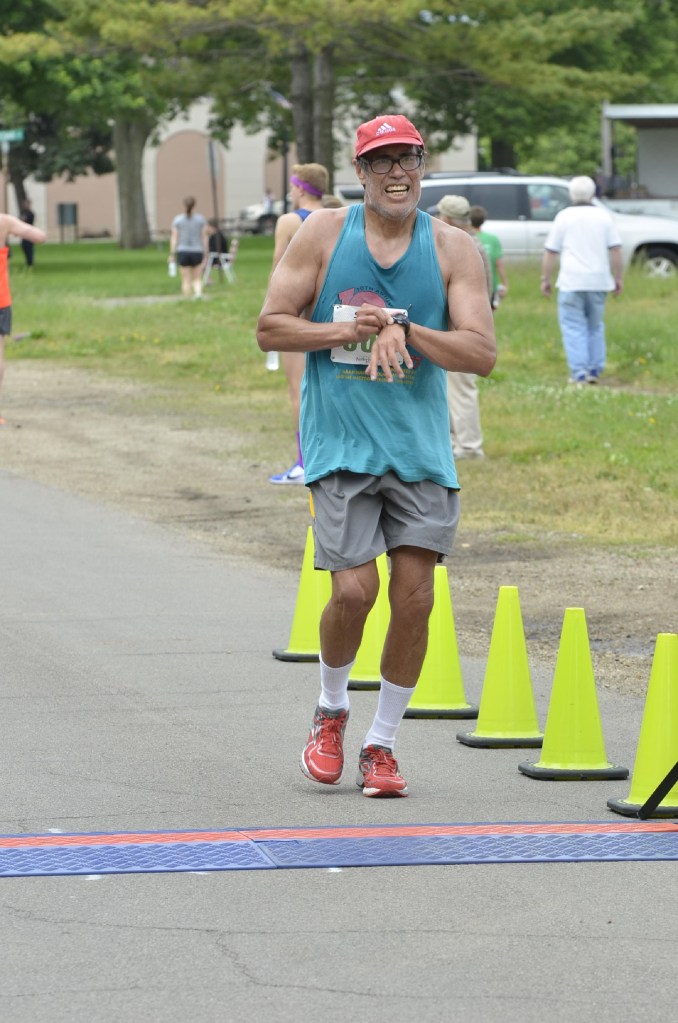
Visually: 1982, 2000, 2005, 2012, 2016, 2019, 2024. I am approximately the same weight in each photo (a little lighter in 2000) but the body composition is very different.

Aging: what is causing my slowdown and why I am taking it so hard

First of all, I want to make it clear: I was never an athlete. I played football and wrestled in high school and, well, wasn’t very good. Most of my adlult sports were indulged informally at gyms and in public competitions. Bests: bench press (gym) 310 (1987), deadlift 410 (gym; 1980’s), 5K swim (open water) 1:36 Chicago, 2008, 1:34 (pool, 2010), mile run 5:30 (1980), 5:59 (1999), 5K run 18:57 (1982), 10k run 39:50 (1982), half 1:34 (1999), full 3:33 (1980), 3:38 (2000). These are “no one cares” times for male 40 and under.

But, if one looked at the results in the paper (where they used to appear), you’d see me typically in the upper 1/3 to upper 1/5’th. But there was a reason for that: I was a younger male, period. That is all it was.

I still remember a 15K run that I ran on Quantico in 1981: it was open to civilians but the crowd was heavily Marine. They lined up by 3 mile time: 15 minutes, 17 minutes, then 19 minutes (when I lined up. along with a slew of young Marines who, well, looked a lot like me). And we more or less finished together. (time: 1:04:04)

Well, now I am no longer young. I am 65 and I had to give up running in 2020: knee ache at the top of the shin after runs. I have no cushion in my knees any longer. And so I walk.

It was bad enough that I was walking 5Ks in just under 34 (judged PR was 30:41, unjudged was 29:xx, but this was in 2003-2004) and I walked a 4 miler in just under 44 minutes. But the half marathon: now 3:05…and my last 5K was a glacial 38:50. Yes, I had a layoff due to my knees (reduced walking, no hard aerobic training)

But my goodness: my days of finishing with the “hard bodies” are long over; I now finish with the “old, wounded or not in shape” brigade.

And as far as the slowdowns (half marathon walk PR was 2:17 in 2003): age certainly plays a large role. But an equal role is played by my numerous setbacks: knees (meniscus tear in 2007, operated on in 2010), lumbar (2020-2022 nightmare) and now knees again. Every setback: I recover but never fully; after I recover, my age graded performance goes down.

Similar is true for weights: in 2021 I had a shoulder injury that my bench press never quite recovered from, and my having to take my leg drive out (lumbar stenosis) hurt me as well. 200 lb is long gone.

But: I still can enjoy these activities; I just have to accept that I am now firmly in the rear of the pack, and that my previous stint in the 80’th percentile was about my being a younger male, period.

When it shows up…

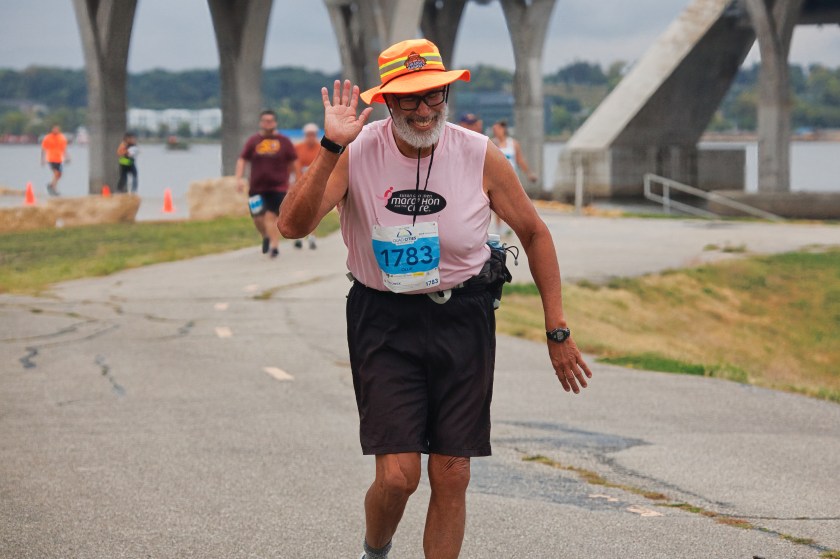
Here are two photos of me at Quad Cities: the first is me a few days ago:

Quad Cities Marathon – Photo by Tom Moye

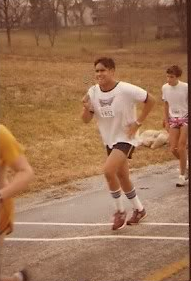
Next is me at the first Quad Cities Marathon in 1998. I weigh the same in both photos.

The body type sure looks different, no?

Today: I did 5 sets of 5 singles (scapular/regular), sets of 5
bench: 10 x 134, 8 x 145
incline: 5 x 134, 4 x 134 (missed rep 5), 10 x 115
trap bar dead (all with 4 inch handles) 10 x 134, 10 x 184, 10 x 224, 10 x 240

and 2 commuter walks totaling just over 2 miles.

My history at Quad Cities:

Quad Cities History
1998: 3:55 as a runner (hot)
1999: 3:45 as a runner
2000: 1:40 for half of a relay
2001: 1:49 for half marathon (week after giving blood)
2002: 4:44 marathon as a walker
2004: 5:12 marathon as a walker
2005: 5:34 marathon as a walker.
2007: DNF at mile 23 (walker)
2008: 2:25 half marathon (walker)
2009: 5:28 marathon (as a walker)
2010: 2:39 half marathon (as a walker; knee surgery in July).
2011: 2:22:27 (half marathon powerwalk)
2013: 2:20:59 as a runner
2014: 2:24:17 powerwalk.
2016 DNF mile 20 (run/walk) heat
2017 DNF mile 20 (walk) heat
2018: Marathon powerwalk 6:14:11.
2019: Marathon powerwalk 6:42:06

2020: virtual 1/2 3:33:50

2024 Half Marathon walk 3:03:37

Not what I had hoped for.

Note: the Quad Cities Marathon races: I did the first one (marathon, as a runner) in 1998. I “ran” a 3:55 on a blistering hot day. I’ve done this race many times, including virtually in 2000 and I power walked the marathon several times.

So, this time, I treated myself to a hotel right at the start line (loved it) and did the half marathon. I was kind of cool to leave my room 20 minutes before the start.

Weather:

Cloud cover, not quite 70, but very humid. That made it slightly tough, but it was easier weather than the Mahomet race this year.

I made some mistakes not eating enough for dinner last night and the wrong stuff pre-race. I should have had pancakes, toast, bagels, etc. And I let my electrolytes get too low. Nuun worked better; Powerade zero is not strong enough. Should have used tablets and taken in some calories.

But, nevertheless, I wasn’t really hurt by this until the very end:

1: 12:59

2: 13:46 (bridge)
3: 13:03

4: 13:14
5: 13:39 (1:06:43) (almost 1 minute behind Mahomet)
6: 13:21
7: 13:17
8: 14:12 (bridge) 1:47:34 (1:30 behind Mahomet)

9 13:47 (tired)
10: 13:42 (2:15:04, 20 second behind my Mahomet pace)
11: 14:44 (reality)
12: 15:34 (gone; 3 hour pacer catches me)
13: 16:34 (survival)

3:03:37 final time. I did not collapse as badly as I did at Mahomet but, again, different weather.

After the race: had to use the bathroom twice, threw up twice (in the room; lost the ability to digest water for a while) but I was able to sip a diet pepsi on the way home.

So, yes, I made more than 4 minutes worth of mistakes BUT the reality is, at this stage in my life, a 3 hour half marathon walk is HARD. I don’t run anymore and so don’t have the extra cardio, and I am not doing “marathon training” type mileage (maybe 150-160 walking miles per month).

Other aspects: it was fun seeing other runners at the hotel, and lining up at a race again. In February 2022, I thought this period of my life was over for good.

Note: the day before the race, I weighed in at 186. That WAS a good weight for me, back in 2012. I no longer have the muscle mass to justify weighing that now.

Before the race, I saw Roger Mohr and MarySue Baker (and her husband). I chatted with a few half marathoners through the race and cheered on the lead marathoners as they passed us.
One minor mistake: I should not have gotten in front of the 3 hour pacer; I followed the 2:50 pacer who had a rough day. Both got away from me in the final 2 miles (see the pace).

September 2003: 2:17 (Appleton Fox-Cities powerwalk division)
January 2008: Austin 30K 3:50:56 (about 2:40 for the half marathon split)
September 2008: 2:25:13 Quad Cities
September 2010: 2:39:13 Quad Cities (surgery that summer)
September 2011: 2:40:53 IVS
September 2011: 2:22 Quad Cities
January 2012: 2:34 First Light
June 2012: 2:30:18 Galesburg
September 2012: 2:24:46 IVS
April 2014: 2:25:26 Peoria Heights
May 2014: 2:19:15 Peoria
September 2014 2:35 (IVS)
September 2014 2:24:17 Quad Cities
September 2015 2:38:13 IVS
June 2017: 2:47:24 Galesburg
July 2017 2:42:19 Chicago RR
August 2017 Mahomet Half marathon 2:52:33
October 2018 Whisky Daddle Half Marathon 2:29:23

August 2024: Mahomet Half Marathon 3:05:09.

September 2024: Quad Cities Half Marathon 3:03:37

Aging: it is tough. Look at the stats for both the half marathon and the full: (in order).

Reality: as a walker, I will be back with the elderly, the injured and with those who are not in great shape or not serious runners. The days of being around the younger hard-bodies is over forever, for me. But, if you look at me, I fit right in with the groups that I finish with.

Training/working out at 64

I am amused by this song: I am 64. And no, being 64 is not the end of the world. But I am in uncharted territory (living what I’ve never lived before). And yes, the old-timer remind me: “it gets worse.”

Today’s walk was instructive:

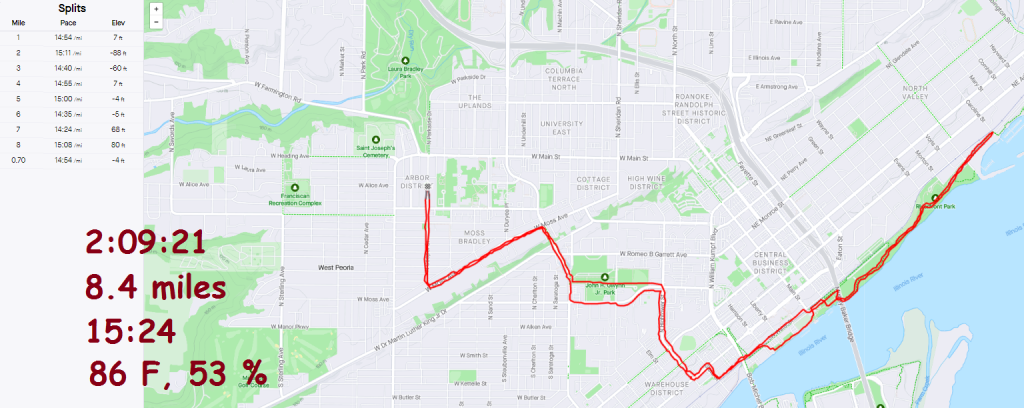
Yes, it warmed up to 86 F, 57 percent humidity (error in the meme)

Now the walk did NOT start off well. I was 16 minutes at the turn off of Moss (just over 1 mile) and I was feeling some left glute/hip tightness at Dozer (just over 2 miles. I gave some thought to just turning around and going home; instead I stretched and continued. I was glad that I did.

Oh, there is some glute soreness and yes, it is lumbar related. It happens. And I WAS fatigued, just a bit. How I could tell: the tightness..my getting irrationally irritated by cars and bicycles (none of which were bad, AT ALL..and yes, I kept my irritation to myself since it was MY problem, not theirs).

But here is where experience came in: instead of angrily pressing the pace, I just relaxed, tried to focus on pelvic tilt and angle (I have stenosis due to spondylolisthesis) and focused on the mechanics of walking. And the pace picked up a bit. I walked to the driveway of the old marina and turned around; going out I stayed on the sidewalk of Water Street until the Gateway building (to avoid the Farmer’s Market foot traffic) and on the way back, I walked along the seawall, and made some other adjustments. The return trip took 1:03 and that was net uphill and done in hotter temperatures; the down trip took 1:06.

So, while I was not pleased with my lack of speed, it was not much of an effort, and I did have tough walks on last Saturday (Steamboat 4 in 43:44 plus 4 more miles), Tuesday (15K at 14:44) and Thursday (“fast 4 on the track”). I have to pay attention to cumulative stress.

And this leads to the topic of this post: working out while older. I’ll list some things just off of the top of my head:

  1. Chronic conditions. I have to be careful here. On one hand, NO ONE my age is not going to have aches and pains. My past areas: knees, shoulder, lumbar. They WILL act up from time to time. Pain that is highly localized and does NOT go away with warm is way I pay attention to. I rarely take pain pills; I haven’t since my bout with COVID in the winter of 2023. I also have to modify exercises, delete others. Part of the reason I film a few sets is to see if I am aggravating some condition of mine.
  2. Body responses Yes, my walking times ARE slower and the weight I can lift is lighter. There is nothing I can do about that. But I can pay attention to things like “I don’t do well in heat so I should back off of my normal pace” or “this stretch/exercise works well for this condition” and I can make it a point to do extra physical therapy for specific things. I do have some concerns about my balance (balance forward) and so I’ll have to practice yoga tree poses and the like. I have to take just a bit more time between sets in lifting, OR do fewer sets if time is tight.
  3. Load management I have less capacity for volume. So; I have to make choices. It seems that I can handle two strenuous walks per week (distance with some intensity and higher speeds), and perhaps two medium walks (slightly longer at a slow pace or shorter at a faster pace), and two heavy (by my standards) press workouts per week. The off days have to be easier.
  4. Testing my limits Deadlift: probably a bad idea as when one tries for a max, the form breaks down a bit. I cannot afford that. Bench: every once in a while is ok, but I have to watch the shoulders. Pull ups: my pull ups have a slight kip to them but trying too many leads to form breakdowns which leads to radiating pain. Walking: take it easy on the races; do them once in a while with a bit of faster walking once a week. Distance: build up gradually. I feel it if I build up too quickly.
  5. Overall life stress This is a tough one. There was a time when I went the hardest when things like work stress were the greatest. That doesn’t work anymore. I have to leave something in the tank for my job. I’ll have to one of my tough walks on the weekend, and limit my tougher sessions to the weekend, juggling them around football games in the fall (I am NOT giving those up).
  6. Keeping perspective. I sometimes get encouraging comments on my Youtube videos…that would be appropriate were I a 24 year old just starting out. But I am not that; I am on a downward trajectory and I am working to retard the slide as best I can; to slow the rate of my decline. Decline I will. Local races: well, I have to remember that 2 years ago, I was doing 1-2 mile walks. That I can do them at all is something to be grateful for. But the reality I will be finishing with the elderly, the injured and the overweight. The days of finishing with the “hard bodies” is long gone. I still remember 1985-1986. I was at my strongest; I worked up to a 300-310 bench press. I weight about 230 lb (45 more than I weigh now) and decided to do a local 5K (on the campus of St. Edwards University). I routinely ran 2-4 miles per day. My time: 23:15, or a 7:30 pace. My trying to run that pace now would be a complete joke. Yes, my waist was 4-6 inches wider than it is now. I have to remember that when I get discouraged by not being able to stay up with someone who does not look in good shape.

Bandwagons and my first marathon

I am still thinking about the posts about some in the running community “not being welcoming” (whatever that means) to newer or slower runners.

That got me to thinking about what I saw recently, at an Indiana Fever WNBA game. Some lady had on a shirt that said “I watched women’s basketball when it wasn’t cool” and I had to smile. I did too: University of Texas from 1985-1991 then Bradley 1991-present. I’ve had the pleasure of seeing a woman’s final four (1986-1987…front row seats, no less!) and watching several highly ranked college teams, including several national championship teams.

But yeah, there are those new to the sport, either as fans or participants.

Back in 2022, the Illinois football team went 8-5, which, by Illini football standards, is a breakout season. And I remember long loyal fans posting stuff about bandwagon fans; many asked for tolerance of them.

And, I wonder if there is some of that going on between those who have been running a long time vs those new at races (e. g. the newbies lining up way too far up front, running/walking 4-5 abreast, coming to a complete stop without warning and realizing that there may be some behind them, going out way too fast and clogging things up, ESPECIALLY on trail runs, etc.)

And there are those like me, who kind of miss being with the “hard bodies” running the 6-7 minute miles and are now at the back of the pack with the slow, lame, overweight and fellow old people. I remind myself that walking slowly is a lot better than not being able to walk at all. I don’t love being this slow, but I love being able to walk and beat most of the current race cutoffs.

And I have to remember that, back in the day, I, in my current state, would have been too slow to make the cutoffs for many (most?) of the races. It was common to have 5 hour cut off for a marathon (San Antonio back in 1981) I ran a 3:48 and felt like an absolute failure.

So, without the army of slower runners, there would be no races for me to finish.

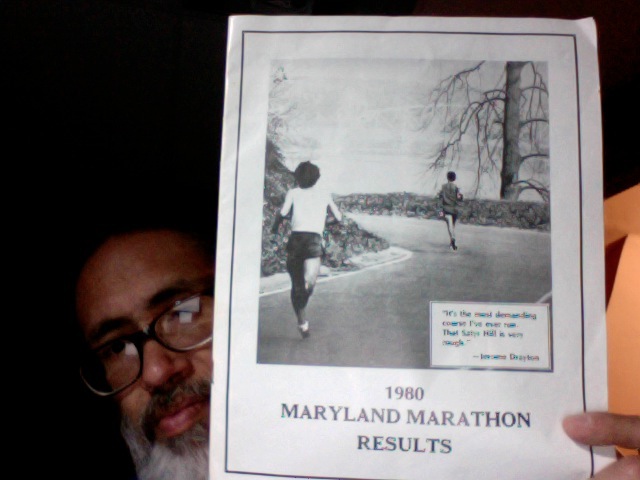
That leads me to think about my first marathon: the Maryland Marathon in 1980:

During my senior year in college, I decided to run the Maryland Marathon. That was me at about mile 18 or so; note the cotton shorts, cotton shirt and the New Balance 730s. Those were state of the art shoes back then.

Though I had several 50 mile weeks, I did no run over 15 miles. So the marathon was a bit of a rude shock. I hit mile 10 in 1:15, half way in 1:37 and slowed to 2:38 at mile 20. The finish: 3:33. Boy, was that last 10K a death march! It wasn’t just for me though; I managed to keep something like a shuffle (and flipped off a kid who said “here is a fat one”) and people were walking at this point; not everyone of course.

My buddies (who went to the race with me) ran 2:38 and 2:59. I ran 3:33 for 1054 out of 2229 men; the median time for the men was 3:36. There were 201 female finishers; two friends of mine finished in 3:30. The median female finisher was 4:05.

How do I know this? I still have the program!

I know that some racewalker finished in the 4:30-4:40 range; I remember asking “is that good?”

I knew that Olympic walkers walked at about 7 minutes per mile (3:05 pace) and didn’t know what a “good but not elite” walker would do.

Now, I wonder why the median time for both the women and men were so much faster than present day median times, even among the younger age groups.

It isn’t age, though the marathon used to attract a somewhat younger crowd; still the median Maryland Marathon time is about 30 minutes faster than the current median for men 20-40 by the above table that I linked to.

My guess is that more average people are attempting them now (it might have been more of a “sporting minded workout-bro thing”; something for people who had a background either in sports or in military physical fitness and the like. I have no data to back that up though.

Or could be that there was more of an emphasis on the 10K back then and people then moved up to the marathon after they’ve had some running under their belt.

And it could be that the current popularity of the marathon means that it is attracting those with no talent for it.

Example: one of my older buddies was a speed burner in college. He ran the then 440 yard dash in something like 47-48 seconds (slightly faster 400 meter time). Yet, his time for the 2 mile was over 13 minutes, 1 minute slower than I! And his marathon PR was about an hour slower than mine. He was faster than I ..a LOT faster but he has no slow twitch fiber at all (ok, very little of it).

Caution: when I talk about SLOW in a marathon, I am talking about people *I* might see were I to try one again; over 6 hours on a normal road course types. I used to consider 4-5 hours to be super slow but now, that is well beyond what I can do.

The running community and new, sensitive, slow runners..

I am sort of new to Threads and, I think due to my Instagram preferences, I’ve been shown a bunch of recommended posts about distance running, especially about those who run public races.

There are many topics of debate and discussion. One of them is about the tendency for the slower runners to overvalue finishing long races like marathons and undervalue running shorter races faster. These are the types that are more impressed with a 4:30 marathon than a 4:30 mile; the latter is orders of magnitude harder to do. Example: as a younger man, I’ve showed up fat and out of shape and broken 4:30 for a marathon. But my fastest mile ever is only 5:30, and that about killed me.

But that isn’t what I want to talk about here.

It seems that many slower runners (e. g. the type that I can beat walking..or used to be able to beat while walking) are thirsty for affirmation from those who are good at it.

Here is such a thread. TL;DR: she was travelling by public transportation to a half marathon, overheard someone saying that they were going to a half marathon.

“I told him that I was too, we had a nice chat for a couple of minutes. Then he told me his target time and asked mine. (1/2) I cheerfully replied that I’d be about an hour behind him and he instantly lost interest in the conversation. It just stopped, he didn’t even look at me for the rest of the journey.”

Now of course I was not there so I don’t know the facial expression, if the guy she was talking to had other stuff on his mind, or whatever.

But, I’ll just say this: my PR is 1:34 (1999) and I had little in common with those running, say, 1:05 or faster. The faster runners: they were concerned with racing (e. g. dropping the competitors), pushing themselves to the limit, etc.

I, on the other hand, was more concerned with time/pace. My catching someone meant I’d finish 134’th instead of 135’th…not much difference. I was after a PR, or “fast” (for me) time and the calculations are different. The mentality is different and the training is certainly different.

Now, well, I am looking to get under 3 hours as a walker (IF I can get to the 1/2 distance at all) and not hurt my back in the process. I am worried about cut offs, aid stations running out of water, keeping nausea under control (keeping the ability to digest water) and increasing heat (an extra 90 minutes can mean a good change of temperature)

I have little in common with the sub 1:40 runners; I am more likely to talk to the slower people (slower runners, older runners..overweight runners and other non-elite walkers).

And I am ok with that. Evidently, some of the newbies aren’t.

So, what is going on?

I think this is the difference:

“Our community does not talk enough about how deeply unwelcoming it can be to beginners. For goodness sake, we all started with couch to 5k or something once upon a time…”

And that is absolutely UNTRUE for me! In fact, it may have been untrue for most of the runners back in 1980, when I started running in public races.

My background: high school sports, college rowing and club judo, and the military. Back in high school I used to run for conditioning purposes. My times: 5:54 for the mile (as a 210 lb lineman) and 13:30 for the 2 mile. In college (Naval Academy) these improved to 5:30 for the mile and 19:30 for the 3 mile (roughly 20:20 for a 5K) before I started to dabble in public road races.

Furthermore: I had experience on the playing field and on the practice field. I had struck out, made errors, missed tackles (once leading to a TD), missed blocks, missed free throws, gotten pinned and had coaches “gently” suggesting how I might improve my game. I also had experience in the military, getting yelled at by Marine officers, etc.

So, going into public races, I expected them to be hard and I well understood that there were levels to it. I was a “plodding fitness runner” and could not be expected to be seen in the same way as those who were good at it.

I wonder: the attitude about races appeared to be different in that era. I know that average times were much faster. Whether that was because most runners of that era came in with sports experience OR had team experience themselves, or some other factor, I do not know. Running clubs had groups, but they tended to be for those who already worked themselves up to a certain level.

Now I do miss those days. I tell myself I missed the comradery of the performance seeking runners (most of those I ran with cared about their times) or do I just miss my younger, better working body.

Now to my workout of the day. I started my PT at about 8, walk at 8:30 and finished..yes..about noon. I took waaaay too long. But I had a nice lag between finishing my walk (9:30) and really getting going with the pull ups (about 10). I got water, stretched some more, etc.

Walk: one loop course: 56:50 at the 4 mile mark 4.15 in 59 minutes. 42:40 at mile 3. It was perfect weather.

Now to the weights: did super setting with rotator cuff, monster walks and psoas marches:

10 pull ups, 7 chin ups, 5 chin ups, 7 chin ups, 5 chin ups, 10 pull ups, 7 pull ups, 5 chin ups (to make up for bad reps) 56 reps in total.

Bench press: 5 x 134, then 3 sets of 5 x 154 (big red plates), then 10 x 134 (wanted more). Lots of rest between sets here.

High incline (tied in) 8 x 90, 8 x 90, 7 x 90 (lots of rest between sets 2 and 3)

curls: 3 sets of 10.

When I look at this I think “gee, this isn’t much.” And yet it took time.

2019 in review

Here is my 2019 in review. I posted photos that are meaningful to me. The first one is collage of “friend” photos.

Here is the “where” (many of the “wheres” anyway)

January

February

March

April

May

June

July

August

September

The TBK Bank Quad Cities Marathon

October


November

December