The Brutal reality of going pro in sports

A few years ago, I was at a Chiefs game. A pop foul came my way and an age peer (60s) was standing just behind me, to my right. He reached out his hand and snatched the ball out of the air.

I looked at him wide-eyed and said “you must have played.” He got a “happy/sad” look on his face and admitted that, at one time in his life, he was a A league minor league player; he now had an office job related to baseball.

And yes, to play A level minor league baseball, you have to be better than the vast majority of college players, who in turn are better than the vast majority of high school players, who I think are pretty good.

But only about 10 percent of those that I watch at Chiefs games will become a Major League player. Just being excellent won’t get you there.

And that reminds me of these two threads posts:

Here is a 28:00 10000 meter, 1:48 800 meter runner who works at McDonalds to finance his training. Yes, he could run for some college teams and get financial assistance for his education. But his times need to be something like 27:20 or 1:43 to even sniff earning a living through his running.

Then I read this inspiring story of a runner who progressed from a 5:26 mile in 9’th grade to a 4:07 in college (as a senior) to a 3:59.37 three years after college. Only a tiny percentage of all middle distance runners have gone sub 4 for a mile. He IS elite but…well, he needs to be at least 10 seconds faster (a quantum leap at that level) to even sniff a pro contract. He won’t be earning his living as a runner, despite being elite.

And that is what it is like. An average engineer can make a nice living, as can, say, an average accountant. But even an elite athlete can peak out before the “earn your living at it” level.

Marathon: you do not “need” to do one..and it is ok to wait.

This post on Threads lead to a rather sharply worded response from me.

Note: the account holder DOES post some good stuff; I can recommend the account to runners. But..

“Excuse?” I suppose I can interpret that as him talking to someone who WANTS to do a marathon but is trying to talk themselves out of it. And, to be fair, that might apply to a group of people that is larger than the group that I am in.

Yes, I’ve finished the marathon (or beyond) distance 62 times (a few times fewer if you do not count my DNF in the 100)

And, no, I was not good at it. My PR as a runner is 3:33 in 1980, master’s is 3:38 in 2000. I did several as a walker (walking 100 percent of the time) and my last time was in 2019; it took me 6:42 (walker)

No, I am never saying “never again”, but given the tenuous health of my knees (currently tolerating 10 miles fairly well) and lumbar, I am NOT doing a marathon in the foreseeable future. And that is right decision, for ME at my current stage in life. Now, if I drop from 195 lb to, say, 178 lb…who knows? Right now, 10 miles is very comfortable but I’ll need 18-20 miles to feel that way before I start looking. It *could* happen, though I don’t see it as likely.

But here is my point: I did my first marathon when I was 21 and, frankly, I did not know what I was doing. But I was doing 15 miles at 7:40-8 minutes a mile, and could do a 5:30 one mile and a 19:20 3 mile (just at 20 for a 5k) and had run for sports for YEARS. I did not go from “couch to marathon.”

I honestly think that way too many never give their bodies a chance to adjust to running first and end up walk/jogging/shuffling to a 6 hour plus marathon.

And, well, the marathon is hardly the pinnacle of running achievement. For example, a 22 minute 5k is much better accomplishment than a 5 hour marathon.

As an aside, I talked to the young man who fit me for walking shoes. It turns out that he is pretty proud of his sub 2 minute 800, and he SHOULD be. That is harder than people think.

Aging and working out: right now

I’ve wanted to talk about this for a while. What is different about my workouts now than before? Note: I am 65

Of course, I’ve changed what I do: running no longer works (severe patellofemoral osteoarthritis in each knee) and swimming the crawl: I have not learned how to NOT extend (arch) my lower lumbar. And I’ve modified other exercises:
Mostly trap bar for the deadlift and wagon wheel plates for the straight bar (mostly), taking the leg drive out of the bench press (feet on a chair) and switching to the high incline (supported) instead of standing shoulder press. Pull ups: keep the knees in front of the body. This induces a small “kip” which would DQ me in a competition.

But here is the major stuff:

  1. Lots of daily PT for the lumbar, shoulder and a bit for the knee. I do this in the morning.
  2. Longer recoveries are needed after strenuous workouts. Go too long or too hard, and it affects my job. It is even more difficult to climb stairs.
  3. Aches and pains: I almost always have them. But they are far worse if I don’t move. So, it is workout and hurt a little bit (at first) or do nothing and hurt a lot more.
  4. Recovery from injuries or flare ups: MUCH longer these days. This is why I am more conservative.
  5. Pushing my limits: FAR less frequent these days. I rarely try for a max effort with the weights or with a walking race. Recovery takes longer and I want to limit the risk of injury.
  6. Performance! At my current bodyweight: at one time in my life, I could bench press 260 lb (310 is my max, but at 40 lb heavier body weight) I could do a set of 20 “less than perfect” pull ups; now 7-9 is a challenge. I can’t quite get the 10’th cleanly. Pull ups used to be 20-10-10-10 or 15-15-10-10. Over time I’ve changed to doing sets of 5-7 and even singles. Walking: last year I got under 11 minute miles for a 5K and 4 mile race, and 3:05 for the half. In terms of my walking, my unjudged PR (not being sloppy) is 29:2x and half (monitored) was 2:17 but this was 2003. My judged PR: 30:42 and 20k was 2:24 (about 2:33 for the half) Again, this was 2003. As a runner: 19:00 for the 5k, 1:34 for the half (1982 and 1998 respectively) .

In terms of the 5k (a nice benchmark), I said goodbye to sub 20 in 1999 (last did it in 1998), sub 22 in 2002, sub 24 in 2009 and sub 25 in 2014 (last time was 2014)

BUT the good part: at 65, I am feeling the way I expected to feel at 50. At 50, I still had some gusto and still could run the 5K in 24:00 or so, and at 49 I could barely break 7 minutes for the mile. 1999 (at 39) was my final sub 6 minute mile (5:59) 1998 I could run a 5:41 1600 and I last did 5:30 in 1982.

So…no, age is NOT “just a number” for me.

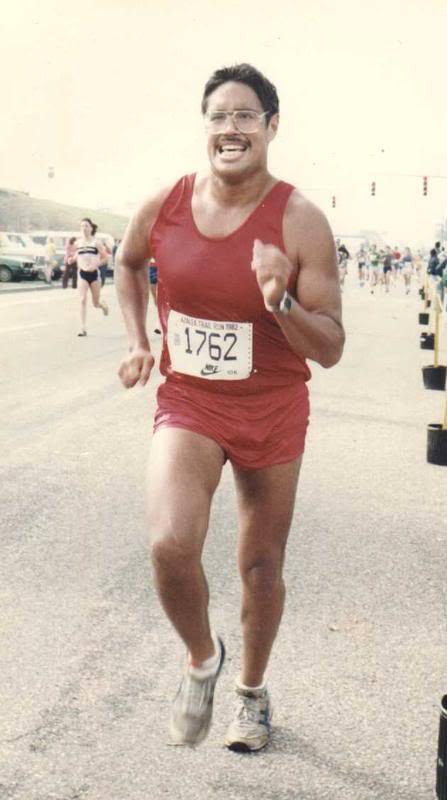
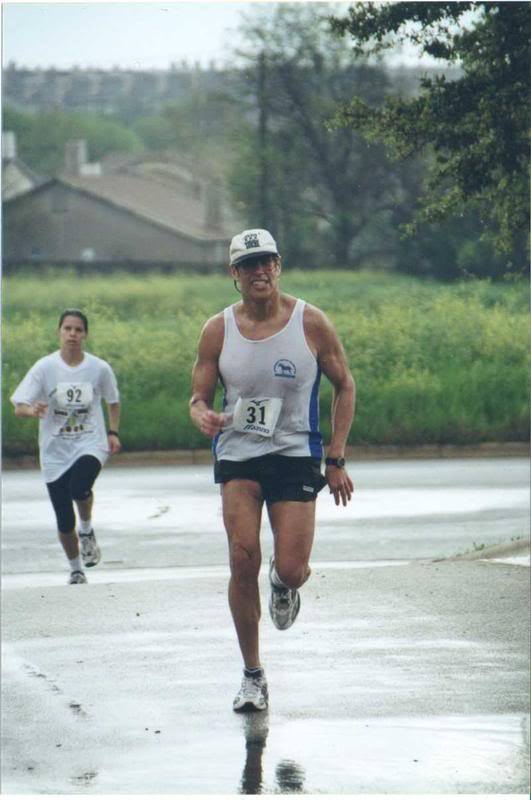
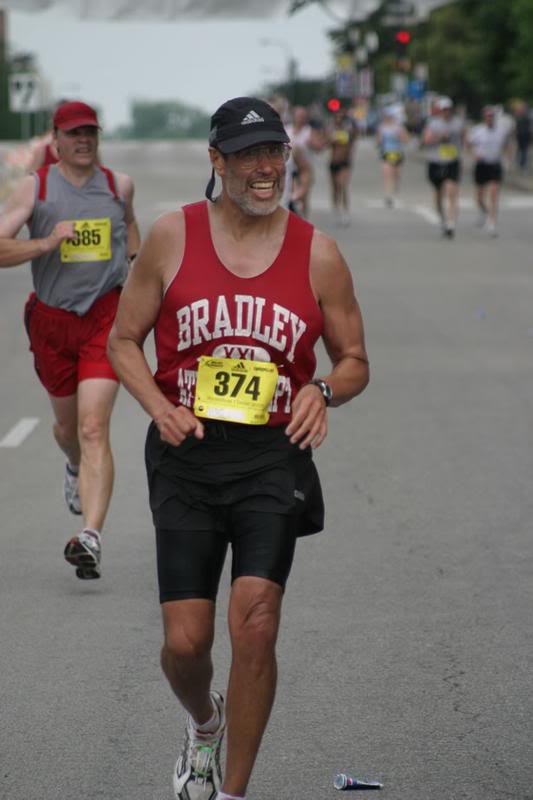
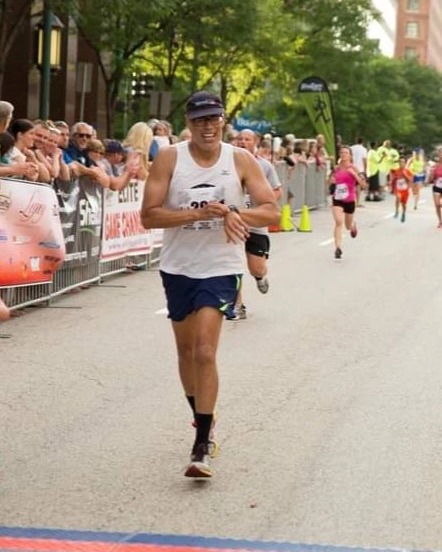
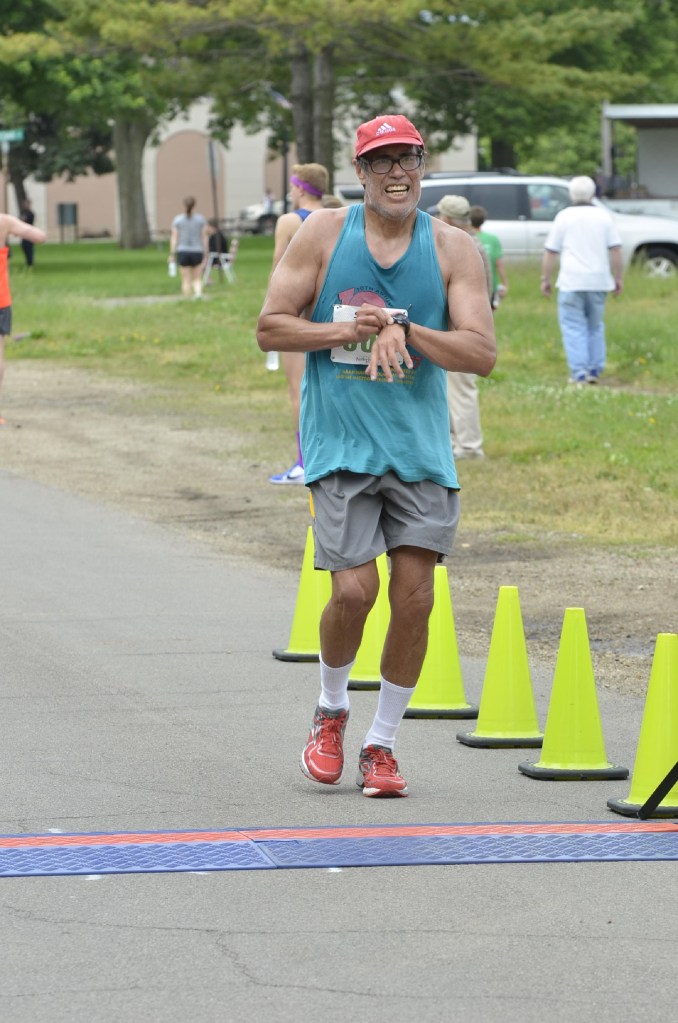
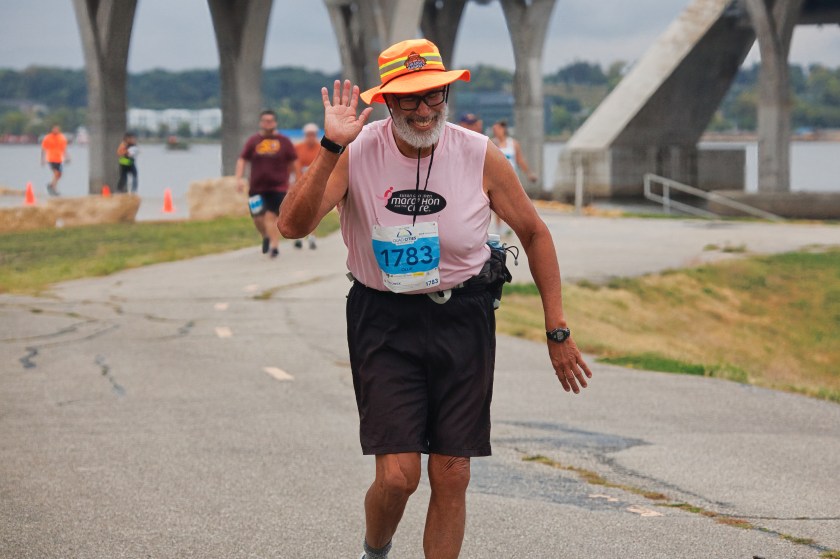
Visually: 1982, 2000, 2005, 2012, 2016, 2019, 2024. I am approximately the same weight in each photo (a little lighter in 2000) but the body composition is very different.

For me: age is NOT “just a number.”

I’ll contrast what working out used to be like with what it is like now.

Today: I did back/shoulder/knee PT exercises for about 20-30 minutes.
Then bike: 36 minutes for 10 fake miles. Then a walk for 36 minutes (slow). 72 minutes of working out AFTER the physical therapy.

In the day: no PT, and the 72 minutes was a 10 mile run on a good day, and 8.5 miles on an off day.

Weight training: usually 50 reps of pull ups, 4 sets of bench press, 3 sets of curls, 3 sets of high incline presses. This takes 70-80 minutes. The pull ups: mostly sets of 5-7 and, on a good day, set of 10.

In the day: many more exercises and more sets. Pull ups: 50 reps were 1 set of 20, 2 sets of 15 on a great day, or maybe 2 sets of 15, 3 sets of 10.

We won’t even count the weights involved, though a set of 10 used to be with 200-225 lb. Now it is 145.

The let’s talk post-workout: in the day, I didn’t worry about going hard in a morning workout. I even did races from time to time. I still had energy to do my job. No longer.

And then there are the chronic conditions: I deal with 3 almost on a daily basis: shoulder, knee, lumbar. That is NOT unusual for 65 and older. In fact, it is to be expected.

The upshot: one has to adjust one’s expectations and one has to be accepting.

Upping the mileage a bit

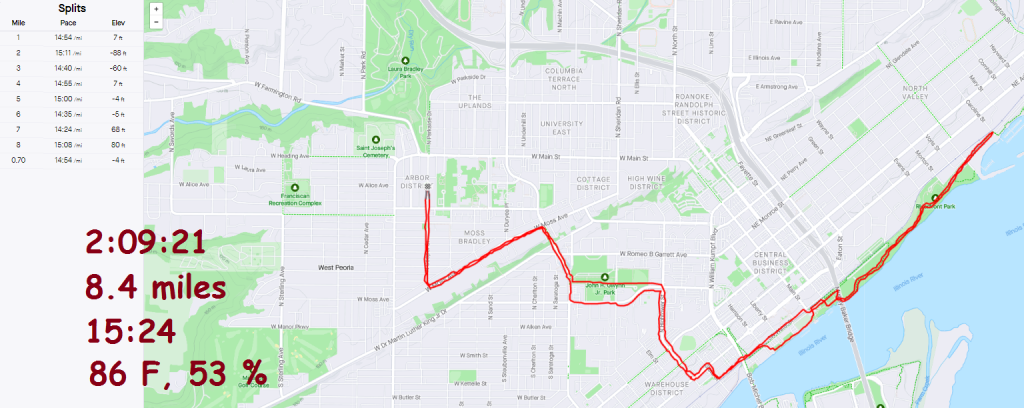
I was in a bit of a grumpy mood this morning, but the weather was very reasonable. It was not as nice as last week, but it was close. So at the end of the 13.65 miles, I was 70 seconds slower than last week. I decided to add a campus loop to up it to over 14 (I got to 14.0 with my watch).

Once again, I did the Moss to Union to downtown, past Dozer park and to the Riverfront. I then continued up the path to Peoria Heights, returned via the old Boredom course, turning off on Columbia Terrace. 58:32 was the Forrest Hill/Monroe to home 4 mile segment.

One bottle of water was enough. And that 3.5 mile climb to Peoria Heights was challenging.

I should be better prepared for my next Half Marathon, heat or no heat.

Age matters: you can see my *walking only* half marathons listed here; I’ve also done some “jog/walk” events, and some as a runner.

But I decided to list some of my better times for each year of running, so you can see my demise (Athlinks only has some of these)

1997: 5:54 mile, 20:02 5K, 42:40 10K, 1:41 half marathon
1998: 5:41 1600 m (5:43 mile), 19:53 5K, 25:41 4 mile, 41:47 10k, 1:39 half marathon, 3:46 marathon

1999: 5:55 mile, 20:36 5k, 26:56 4 mile, 42:27 10K, 1:34 half, 3:45 full

2000 5:45 1500, 20:47 5k, 27:51 4 mile, 44:09 10K, 1:35:27 half, 3:38:12 full

2001: 20:37 5k, 27:56 4 mile, 44:28 10k, 1:37:31 half, 3:40 full

2002: 21:50 5k, 28:12 4 mile, 1/2 1:43, full 3:57 full

2003: 5K 21:59, 4 mile 28:53, half 1:53, full 4:44 (walk)

2004: 5K 23:05 (mostly walking this year) 5:12 marathon walk
2005 5k 23:08

2006 5k 23:05

2007 (walking mostly)
2008 5k 23:56

2009 mile: 1600: 6:54, mile (downhill): 6:42 5K 24:00 (lots of 24:xx)

2011: mile (downhill) 7:48, 5K 25:30 (surgery in 2010)

2012: 1500 7:08, mile (downhill) 7:12 5K 24:34

2013:5K 24:56

2014 mile (downhill) 7:04, 5k 24:16, 24:46 (last one under 25)

2016: 5k 25:56 (final sub 26)

2017: 5K 27:18

2018 5k 28:02
2019 5k 27:34

No more running races after this. All walking.

Athletic Decline with age (in photos)

1980 10 mile run: 81 minutes

1982 10k run: 39:50

1998 Quad Cities Marathon 3:55 (HOT!)

1999 5K run 21:33

2000 10K 44 minutes

2001 Marathon 3:40

2004 3000 meter walk 18:03

2005: 15k run 1:23

2007 5K walk 31:00

2012 15k run 1:36

2014 1 mile run 7:04

2016 5k run 26:00

2018 5K 29:23

2019 15K 1:38

2024 Half Marathon walk 3:05

July 4, 2024 Firecracker

I’ve done a few of these and today, I did another. Iffy weather lead me to drive to the race, walk 1.2 miles before and after.

The race itself: very crowded on the small path; 465 for so crowded on the small riverfront path. Still, the chip helped (47 seconds to the start line) and while mile 1 was crowded, the crowd helped me stay moderate in mile 1 (11:05). which was good for the 74 F, 87 percent humidity, drizzly conditions. More space meant somewhat faster walking in mile 2 (10:41) but I faltered at about 2.8 (small amount of street walking) but even that mile was 11:01. I tried to pick it up and got under 34 by the chip (33:58) and held off Simon and Gail (though their chip times were 13 seconds faster).

Afterward, I was tired. The left glute was achy afterward. Hanging on the playground rings felt good.

I’ve done a number of these (4’th of July..or 3’rd if the 4’th was on a Sunday) and here is my list (looked these up in my old logs)

23 total Independence Days, 24 events, span of 43 years.

1981: 26:53 4 mile (San Antonio)

1982 42:00 10K (Florida)

1983: 50:08 10K (Virginia)

1997: 43:37 10K (Milton, Wisconsin)

1998: 20:40 5K (Peoria)

1999 5:59 road mile (Sat), 21:33 5K (Sunday, Peoria)

2000 47:04 10K (Milton)

2001 50:05 10K (Milton)

2002 49:20 10K (Milton)

2003 1:06:52 (10K walk) Milton

2004 23:31 run (Kyle, TX)

2005: 40:55 5 mile run (Bloomington, IL)

2006 31:11 5K walk (Galva)

2007 31:35 5K walk (Peoria)

2008 31:33 5K walk (Galva)

2011 30:09 5K run (Peoria)

2012 27:46 5K run (Peoria)

2013 27:40 5K run (Peoria)

2014 27:06 5K run (Peoria)

2015 26:48 5K run (Peoria)

2017 30:05 5k run (Galva)

2018 29:23 5k run (Peoria)

2024 33:58 5k walk (Peoria)

Fit AND Fat? Be careful…

Yesterday, I walked books from the house to my office. It was maybe 200-300 meters and four flights of stairs. I weighed the books (in my backpack suitcase) and it was …34 lbs.

But..the footsteps felt harder and I felt it in my knees and hips. And pull ups..no dice; not even one.

So, my point: I am 64 years old; I’ll be 65 in 8 weeks. Carrying that extra weight was WORK, even though it was only 34 lbs. (15.5 kg)

I was once 320 lbs. Now I am just under 190 and I’ve been 195 plus/minus 10 pounds for the past 28 years or so.

When I was 320, well, I still lifted weights and walked, though top walking speed was 18 minutes per mile, as a male in my early 30’s.

And yes, I heartily encourage people of all sizes to work out!

But, I am hear to tell you: the excess weight does add to skeletal stress, and as you age, even if you work out, you will struggle to deal with the extra weight. You won’t stay young forever.

A young person can get away with more. Back in 1985, when I was 50 lb heavier than I am now, I ran a 5K in 23:00. This is a time I have not seen since 2008 or so. Youth matters and it helps you compensate.

Training/working out at 64

I am amused by this song: I am 64. And no, being 64 is not the end of the world. But I am in uncharted territory (living what I’ve never lived before). And yes, the old-timer remind me: “it gets worse.”

Today’s walk was instructive:

Yes, it warmed up to 86 F, 57 percent humidity (error in the meme)

Now the walk did NOT start off well. I was 16 minutes at the turn off of Moss (just over 1 mile) and I was feeling some left glute/hip tightness at Dozer (just over 2 miles. I gave some thought to just turning around and going home; instead I stretched and continued. I was glad that I did.

Oh, there is some glute soreness and yes, it is lumbar related. It happens. And I WAS fatigued, just a bit. How I could tell: the tightness..my getting irrationally irritated by cars and bicycles (none of which were bad, AT ALL..and yes, I kept my irritation to myself since it was MY problem, not theirs).

But here is where experience came in: instead of angrily pressing the pace, I just relaxed, tried to focus on pelvic tilt and angle (I have stenosis due to spondylolisthesis) and focused on the mechanics of walking. And the pace picked up a bit. I walked to the driveway of the old marina and turned around; going out I stayed on the sidewalk of Water Street until the Gateway building (to avoid the Farmer’s Market foot traffic) and on the way back, I walked along the seawall, and made some other adjustments. The return trip took 1:03 and that was net uphill and done in hotter temperatures; the down trip took 1:06.

So, while I was not pleased with my lack of speed, it was not much of an effort, and I did have tough walks on last Saturday (Steamboat 4 in 43:44 plus 4 more miles), Tuesday (15K at 14:44) and Thursday (“fast 4 on the track”). I have to pay attention to cumulative stress.

And this leads to the topic of this post: working out while older. I’ll list some things just off of the top of my head:

  1. Chronic conditions. I have to be careful here. On one hand, NO ONE my age is not going to have aches and pains. My past areas: knees, shoulder, lumbar. They WILL act up from time to time. Pain that is highly localized and does NOT go away with warm is way I pay attention to. I rarely take pain pills; I haven’t since my bout with COVID in the winter of 2023. I also have to modify exercises, delete others. Part of the reason I film a few sets is to see if I am aggravating some condition of mine.
  2. Body responses Yes, my walking times ARE slower and the weight I can lift is lighter. There is nothing I can do about that. But I can pay attention to things like “I don’t do well in heat so I should back off of my normal pace” or “this stretch/exercise works well for this condition” and I can make it a point to do extra physical therapy for specific things. I do have some concerns about my balance (balance forward) and so I’ll have to practice yoga tree poses and the like. I have to take just a bit more time between sets in lifting, OR do fewer sets if time is tight.
  3. Load management I have less capacity for volume. So; I have to make choices. It seems that I can handle two strenuous walks per week (distance with some intensity and higher speeds), and perhaps two medium walks (slightly longer at a slow pace or shorter at a faster pace), and two heavy (by my standards) press workouts per week. The off days have to be easier.
  4. Testing my limits Deadlift: probably a bad idea as when one tries for a max, the form breaks down a bit. I cannot afford that. Bench: every once in a while is ok, but I have to watch the shoulders. Pull ups: my pull ups have a slight kip to them but trying too many leads to form breakdowns which leads to radiating pain. Walking: take it easy on the races; do them once in a while with a bit of faster walking once a week. Distance: build up gradually. I feel it if I build up too quickly.
  5. Overall life stress This is a tough one. There was a time when I went the hardest when things like work stress were the greatest. That doesn’t work anymore. I have to leave something in the tank for my job. I’ll have to one of my tough walks on the weekend, and limit my tougher sessions to the weekend, juggling them around football games in the fall (I am NOT giving those up).
  6. Keeping perspective. I sometimes get encouraging comments on my Youtube videos…that would be appropriate were I a 24 year old just starting out. But I am not that; I am on a downward trajectory and I am working to retard the slide as best I can; to slow the rate of my decline. Decline I will. Local races: well, I have to remember that 2 years ago, I was doing 1-2 mile walks. That I can do them at all is something to be grateful for. But the reality I will be finishing with the elderly, the injured and the overweight. The days of finishing with the “hard bodies” is long gone. I still remember 1985-1986. I was at my strongest; I worked up to a 300-310 bench press. I weight about 230 lb (45 more than I weigh now) and decided to do a local 5K (on the campus of St. Edwards University). I routinely ran 2-4 miles per day. My time: 23:15, or a 7:30 pace. My trying to run that pace now would be a complete joke. Yes, my waist was 4-6 inches wider than it is now. I have to remember that when I get discouraged by not being able to stay up with someone who does not look in good shape.

Bandwagons and my first marathon

I am still thinking about the posts about some in the running community “not being welcoming” (whatever that means) to newer or slower runners.

That got me to thinking about what I saw recently, at an Indiana Fever WNBA game. Some lady had on a shirt that said “I watched women’s basketball when it wasn’t cool” and I had to smile. I did too: University of Texas from 1985-1991 then Bradley 1991-present. I’ve had the pleasure of seeing a woman’s final four (1986-1987…front row seats, no less!) and watching several highly ranked college teams, including several national championship teams.

But yeah, there are those new to the sport, either as fans or participants.

Back in 2022, the Illinois football team went 8-5, which, by Illini football standards, is a breakout season. And I remember long loyal fans posting stuff about bandwagon fans; many asked for tolerance of them.

And, I wonder if there is some of that going on between those who have been running a long time vs those new at races (e. g. the newbies lining up way too far up front, running/walking 4-5 abreast, coming to a complete stop without warning and realizing that there may be some behind them, going out way too fast and clogging things up, ESPECIALLY on trail runs, etc.)

And there are those like me, who kind of miss being with the “hard bodies” running the 6-7 minute miles and are now at the back of the pack with the slow, lame, overweight and fellow old people. I remind myself that walking slowly is a lot better than not being able to walk at all. I don’t love being this slow, but I love being able to walk and beat most of the current race cutoffs.

And I have to remember that, back in the day, I, in my current state, would have been too slow to make the cutoffs for many (most?) of the races. It was common to have 5 hour cut off for a marathon (San Antonio back in 1981) I ran a 3:48 and felt like an absolute failure.

So, without the army of slower runners, there would be no races for me to finish.

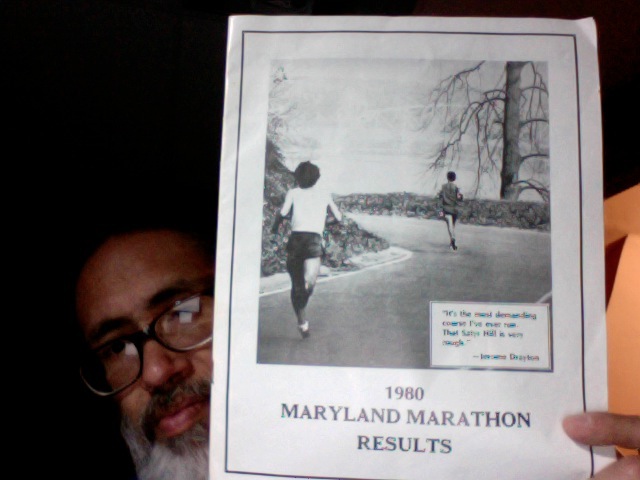
That leads me to think about my first marathon: the Maryland Marathon in 1980:

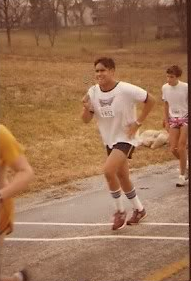
During my senior year in college, I decided to run the Maryland Marathon. That was me at about mile 18 or so; note the cotton shorts, cotton shirt and the New Balance 730s. Those were state of the art shoes back then.

Though I had several 50 mile weeks, I did no run over 15 miles. So the marathon was a bit of a rude shock. I hit mile 10 in 1:15, half way in 1:37 and slowed to 2:38 at mile 20. The finish: 3:33. Boy, was that last 10K a death march! It wasn’t just for me though; I managed to keep something like a shuffle (and flipped off a kid who said “here is a fat one”) and people were walking at this point; not everyone of course.

My buddies (who went to the race with me) ran 2:38 and 2:59. I ran 3:33 for 1054 out of 2229 men; the median time for the men was 3:36. There were 201 female finishers; two friends of mine finished in 3:30. The median female finisher was 4:05.

How do I know this? I still have the program!

I know that some racewalker finished in the 4:30-4:40 range; I remember asking “is that good?”

I knew that Olympic walkers walked at about 7 minutes per mile (3:05 pace) and didn’t know what a “good but not elite” walker would do.

Now, I wonder why the median time for both the women and men were so much faster than present day median times, even among the younger age groups.

It isn’t age, though the marathon used to attract a somewhat younger crowd; still the median Maryland Marathon time is about 30 minutes faster than the current median for men 20-40 by the above table that I linked to.

My guess is that more average people are attempting them now (it might have been more of a “sporting minded workout-bro thing”; something for people who had a background either in sports or in military physical fitness and the like. I have no data to back that up though.

Or could be that there was more of an emphasis on the 10K back then and people then moved up to the marathon after they’ve had some running under their belt.

And it could be that the current popularity of the marathon means that it is attracting those with no talent for it.

Example: one of my older buddies was a speed burner in college. He ran the then 440 yard dash in something like 47-48 seconds (slightly faster 400 meter time). Yet, his time for the 2 mile was over 13 minutes, 1 minute slower than I! And his marathon PR was about an hour slower than mine. He was faster than I ..a LOT faster but he has no slow twitch fiber at all (ok, very little of it).

Caution: when I talk about SLOW in a marathon, I am talking about people *I* might see were I to try one again; over 6 hours on a normal road course types. I used to consider 4-5 hours to be super slow but now, that is well beyond what I can do.