Bandwagons and my first marathon

I am still thinking about the posts about some in the running community “not being welcoming” (whatever that means) to newer or slower runners.

That got me to thinking about what I saw recently, at an Indiana Fever WNBA game. Some lady had on a shirt that said “I watched women’s basketball when it wasn’t cool” and I had to smile. I did too: University of Texas from 1985-1991 then Bradley 1991-present. I’ve had the pleasure of seeing a woman’s final four (1986-1987…front row seats, no less!) and watching several highly ranked college teams, including several national championship teams.

But yeah, there are those new to the sport, either as fans or participants.

Back in 2022, the Illinois football team went 8-5, which, by Illini football standards, is a breakout season. And I remember long loyal fans posting stuff about bandwagon fans; many asked for tolerance of them.

And, I wonder if there is some of that going on between those who have been running a long time vs those new at races (e. g. the newbies lining up way too far up front, running/walking 4-5 abreast, coming to a complete stop without warning and realizing that there may be some behind them, going out way too fast and clogging things up, ESPECIALLY on trail runs, etc.)

And there are those like me, who kind of miss being with the “hard bodies” running the 6-7 minute miles and are now at the back of the pack with the slow, lame, overweight and fellow old people. I remind myself that walking slowly is a lot better than not being able to walk at all. I don’t love being this slow, but I love being able to walk and beat most of the current race cutoffs.

And I have to remember that, back in the day, I, in my current state, would have been too slow to make the cutoffs for many (most?) of the races. It was common to have 5 hour cut off for a marathon (San Antonio back in 1981) I ran a 3:48 and felt like an absolute failure.

So, without the army of slower runners, there would be no races for me to finish.

That leads me to think about my first marathon: the Maryland Marathon in 1980:
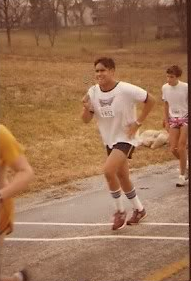
During my senior year in college, I decided to run the Maryland Marathon. That was me at about mile 18 or so; note the cotton shorts, cotton shirt and the New Balance 730s. Those were state of the art shoes back then.

Though I had several 50 mile weeks, I did no run over 15 miles. So the marathon was a bit of a rude shock. I hit mile 10 in 1:15, half way in 1:37 and slowed to 2:38 at mile 20. The finish: 3:33. Boy, was that last 10K a death march! It wasn’t just for me though; I managed to keep something like a shuffle (and flipped off a kid who said “here is a fat one”) and people were walking at this point; not everyone of course.

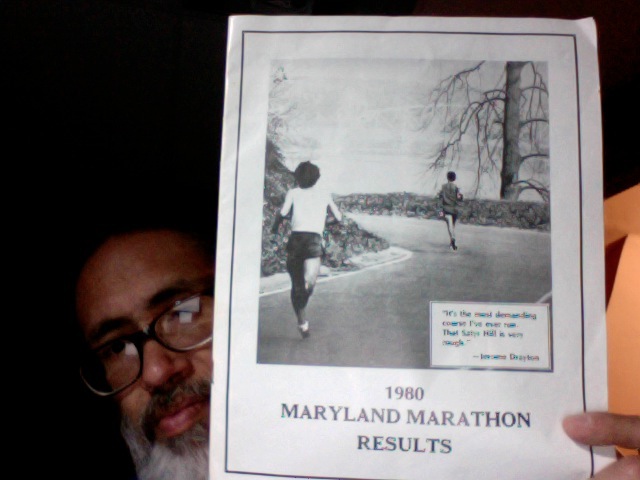
My buddies (who went to the race with me) ran 2:38 and 2:59. I ran 3:33 for 1054 out of 2229 men; the median time for the men was 3:36. There were 201 female finishers; two friends of mine finished in 3:30. The median female finisher was 4:05.

How do I know this? I still have the program!

I know that some racewalker finished in the 4:30-4:40 range; I remember asking “is that good?”

I knew that Olympic walkers walked at about 7 minutes per mile (3:05 pace) and didn’t know what a “good but not elite” walker would do.

Now, I wonder why the median time for both the women and men were so much faster than present day median times, even among the younger age groups.

It isn’t age, though the marathon used to attract a somewhat younger crowd; still the median Maryland Marathon time is about 30 minutes faster than the current median for men 20-40 by the above table that I linked to.

My guess is that more average people are attempting them now (it might have been more of a “sporting minded workout-bro thing”; something for people who had a background either in sports or in military physical fitness and the like. I have no data to back that up though.

Or could be that there was more of an emphasis on the 10K back then and people then moved up to the marathon after they’ve had some running under their belt.

And it could be that the current popularity of the marathon means that it is attracting those with no talent for it.

Example: one of my older buddies was a speed burner in college. He ran the then 440 yard dash in something like 47-48 seconds (slightly faster 400 meter time). Yet, his time for the 2 mile was over 13 minutes, 1 minute slower than I! And his marathon PR was about an hour slower than mine. He was faster than I ..a LOT faster but he has no slow twitch fiber at all (ok, very little of it).

Caution: when I talk about SLOW in a marathon, I am talking about people *I* might see were I to try one again; over 6 hours on a normal road course types. I used to consider 4-5 hours to be super slow but now, that is well beyond what I can do.

The running community and new, sensitive, slow runners..

I am sort of new to Threads and, I think due to my Instagram preferences, I’ve been shown a bunch of recommended posts about distance running, especially about those who run public races.

There are many topics of debate and discussion. One of them is about the tendency for the slower runners to overvalue finishing long races like marathons and undervalue running shorter races faster. These are the types that are more impressed with a 4:30 marathon than a 4:30 mile; the latter is orders of magnitude harder to do. Example: as a younger man, I’ve showed up fat and out of shape and broken 4:30 for a marathon. But my fastest mile ever is only 5:30, and that about killed me.

But that isn’t what I want to talk about here.

It seems that many slower runners (e. g. the type that I can beat walking..or used to be able to beat while walking) are thirsty for affirmation from those who are good at it.

Here is such a thread. TL;DR: she was travelling by public transportation to a half marathon, overheard someone saying that they were going to a half marathon.

“I told him that I was too, we had a nice chat for a couple of minutes. Then he told me his target time and asked mine. (1/2) I cheerfully replied that I’d be about an hour behind him and he instantly lost interest in the conversation. It just stopped, he didn’t even look at me for the rest of the journey.”

Now of course I was not there so I don’t know the facial expression, if the guy she was talking to had other stuff on his mind, or whatever.

But, I’ll just say this: my PR is 1:34 (1999) and I had little in common with those running, say, 1:05 or faster. The faster runners: they were concerned with racing (e. g. dropping the competitors), pushing themselves to the limit, etc.

I, on the other hand, was more concerned with time/pace. My catching someone meant I’d finish 134’th instead of 135’th…not much difference. I was after a PR, or “fast” (for me) time and the calculations are different. The mentality is different and the training is certainly different.

Now, well, I am looking to get under 3 hours as a walker (IF I can get to the 1/2 distance at all) and not hurt my back in the process. I am worried about cut offs, aid stations running out of water, keeping nausea under control (keeping the ability to digest water) and increasing heat (an extra 90 minutes can mean a good change of temperature)

I have little in common with the sub 1:40 runners; I am more likely to talk to the slower people (slower runners, older runners..overweight runners and other non-elite walkers).

And I am ok with that. Evidently, some of the newbies aren’t.

So, what is going on?

I think this is the difference:

“Our community does not talk enough about how deeply unwelcoming it can be to beginners. For goodness sake, we all started with couch to 5k or something once upon a time…”

And that is absolutely UNTRUE for me! In fact, it may have been untrue for most of the runners back in 1980, when I started running in public races.

My background: high school sports, college rowing and club judo, and the military. Back in high school I used to run for conditioning purposes. My times: 5:54 for the mile (as a 210 lb lineman) and 13:30 for the 2 mile. In college (Naval Academy) these improved to 5:30 for the mile and 19:30 for the 3 mile (roughly 20:20 for a 5K) before I started to dabble in public road races.

Furthermore: I had experience on the playing field and on the practice field. I had struck out, made errors, missed tackles (once leading to a TD), missed blocks, missed free throws, gotten pinned and had coaches “gently” suggesting how I might improve my game. I also had experience in the military, getting yelled at by Marine officers, etc.

So, going into public races, I expected them to be hard and I well understood that there were levels to it. I was a “plodding fitness runner” and could not be expected to be seen in the same way as those who were good at it.

I wonder: the attitude about races appeared to be different in that era. I know that average times were much faster. Whether that was because most runners of that era came in with sports experience OR had team experience themselves, or some other factor, I do not know. Running clubs had groups, but they tended to be for those who already worked themselves up to a certain level.

Now I do miss those days. I tell myself I missed the comradery of the performance seeking runners (most of those I ran with cared about their times) or do I just miss my younger, better working body.

Now to my workout of the day. I started my PT at about 8, walk at 8:30 and finished..yes..about noon. I took waaaay too long. But I had a nice lag between finishing my walk (9:30) and really getting going with the pull ups (about 10). I got water, stretched some more, etc.

Walk: one loop course: 56:50 at the 4 mile mark 4.15 in 59 minutes. 42:40 at mile 3. It was perfect weather.

Now to the weights: did super setting with rotator cuff, monster walks and psoas marches:

10 pull ups, 7 chin ups, 5 chin ups, 7 chin ups, 5 chin ups, 10 pull ups, 7 pull ups, 5 chin ups (to make up for bad reps) 56 reps in total.

Bench press: 5 x 134, then 3 sets of 5 x 154 (big red plates), then 10 x 134 (wanted more). Lots of rest between sets here.

High incline (tied in) 8 x 90, 8 x 90, 7 x 90 (lots of rest between sets 2 and 3)

curls: 3 sets of 10.

When I look at this I think “gee, this isn’t much.” And yet it took time.

Blood and platelet donation and long walks

Weather: not that bad; 65 F, 84 percent at the start; 80 F, 50 percent at the end. But while the first 6-7 miles were easy (under 30 at Dozer; 36 at Hooters), the final 8 were a real struggle. I was 2:03 at Bishop Hill, 2:40 at the Tower and 3:10 at Sheridan/Northmore (1:55 return) and 3:40 at my second Tower visit. Final 5 miles: 1:12:21; time was 5:04 (did an extra goose loop to get full 20).

I did have to do a trail bypass (parking lot) near the Riverplex. Sights; rabbits, ground hogs and the usual.

Though this was my best 20 mile walk in a long time ..since 2014 I had ONE 20 training walk that was maybe 1-2 minutes faster, and that was on a 50 F degree day. Otherwise, only my first 20 of last year’s marathon (just under 4:44) was faster. I cannot discount that.

Still, the platelet donation on Thursday afternoon had an effect

Your body contains approximately10 pints of blood, one of which you give away during a “whole blood” donation. One pint of blood is also referred to as 450-500 ml, or one unit. Donating one-tenth of our blood may seem hefty until you consider that a car crash victim could need up to 100 pints of blood to survive (1)!

After donation, your body goes to work regenerating the lost blood. Your plasma recovers the quickest, in about 24 hours (9). The Red Cross recommends no strenuous exercise during this period until your “fluid” or plasma normalizes (9). Platelets restore next, within a 72-hour period (13). The oxygen carriers or RBCs – unfortunately for athletes – are the slowest to regenerate, taking four to six weeks to fully rebound (9).

The lag in RBC recovery is an obvious indicator that an athlete’s endurance performance will suffer until pre-donation levels are restored. Several studies have reported significant drops in performance measures from 24 hours to two days post-donation in active young adults, including VO2 max, work rate (4,5,6,7), and time to exhaustion (5). Dellweg et al. reported a 9% decrease in VO2 max, and a 13% drop in maximal work rate following a 500-ml whole blood donation (6).

Now whole blood degrades my “2 hours sustained pace” intensity workouts for 4-6 weeks. Double red cells: ugh. That totally whips me for 2 months or more…the next couple of weeks, my legs are like cement poles.

Platelets: I am usually good to go 3-4 days later..though shorter, medium intensity, medium duration workouts are not affected much. And today, I felt good for almost 3 hours.

My mind

It went something like this: early in my return to running, I built up gradually (first time: via a marathon class) and felt myself getting more confident.

Ultra days: “Lol..today…I’ll stop at a marathon.” No biggie. I’d even do 30-40 mile training walks. No problem.

But with over doing the ultras and increasing age…the failures started to build up..there were MANY bad training sessions; many times when I failed.

Now (and really…since 2010 or so..after my last knee operation ): every long walk is a bit like a race in that I get nervous and worry about failure. The failures live with me. And THAT is mental.

Bottom line: I got it done today.

Baseline walk

Well, am I in shape to train for a walking marathon? There was only one way to find out. Yes, it was warm; 70 F just prior to starting out (87 percent humidity) and 87 F at the finish. Whew. I was 1:01 at 4, 1:16 at 5, 1:29 at the tower and 2:05 at mile 8, and 4:09 at the end of the 15.75 course (took the goose loop) and added an extra .4 past Markin to get 16.

Amusing: I saw Jehovah’s Witnesses near the Farmers Market and outdoor stuff by the River..and animal rights protesters outside the restaurant. I also saw a few from this morning’s 5K.

My mind churned through election stuff while I walked. I saw a few runners here and there. Lots of sun..and some heat conditioning.

So, am I ready to start training? Ugh…15:56 mpm..but I was averaging right at 15 before the temperatures started to climb. The good news: it really wasn’t much of an effort. And training (and weight loss) will make me faster.

I’ll attempt a couple of more longish walks than then reevaluate.

Comment: ok, these are the days where I actually like Peoria: it was a pleasant (if warm) walk; got to see different neighborhoods, good views of the Illinois River, woods, mansions, Riverfront, Dozer Park, etc.